Key points
A Net Promoter Score (NPS) survey asks one question, how likely people are to recommend you, on a scale from 0 to 10.
Scores of 9 and 10 are promoters, 7 and 8 are passives, and 0 to 6 are detractors. Your NPS is the percentage of promoters minus the percentage of detractors.
Follow the score with one open question about the reason. That answer tells you what to fix.
Reuily's Free plan includes the Net Promoter Score question, unlimited responses and your score in the results.
On this page
Want to know whether your customers would recommend you, and why? A Net Promoter Score (NPS) survey answers both with two short questions.
This guide shows you which questions to use, how to read the results and how to send your first survey today.
What is a Net Promoter Score (NPS) survey?
A Net Promoter Score (NPS) survey measures customer loyalty with one question: how likely someone is to recommend you, from 0 to 10. Each answer makes that person a promoter, a passive or a detractor, and your score is the share of promoters minus the share of detractors.
The three groups are:
- Promoters (9 and 10). Happy customers who are likely to recommend you.
- Passives (7 and 8). Satisfied, but not excited enough to tell others.
- Detractors (0 to 6). Unhappy customers who may warn others away.
Because the question never changes, you can compare scores across months, products or teams. The method comes from Fred Reichheld of Bain & Company, who introduced it in Harvard Business Review in 2003.
How to calculate NPS
Your NPS is the percentage of promoters minus the percentage of detractors. Passives count towards the total but not towards either group. The result is a number between minus 100 and 100.
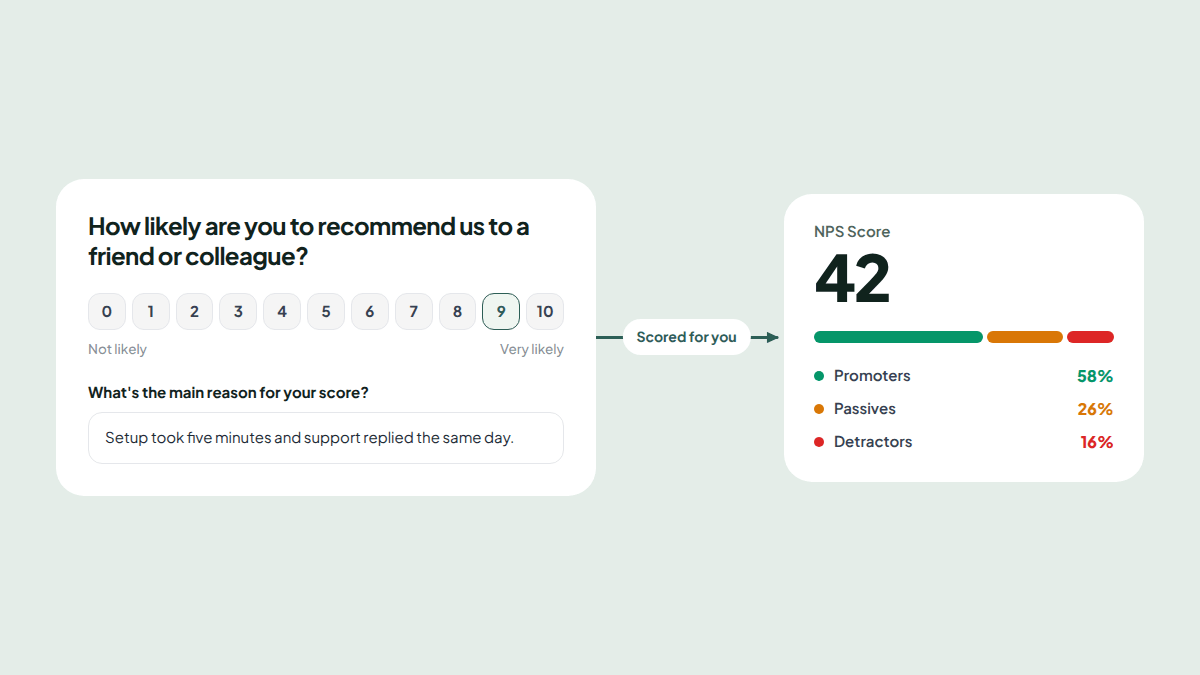
For example, if 100 people answer and 58 are promoters, 26 are passives and 16 are detractors:
- Promoters: 58%
- Detractors: 16%
- NPS: 58 minus 16 = 42
To work out a score from your own numbers, use the free NPS calculator.
You don't need a spreadsheet for this in Reuily. The Summary tab of your results shows your NPS Score, with the share of promoters, passives and detractors, across every response you collect.
NPS survey questions to ask
Every NPS survey starts with the same core question:
How likely are you to recommend us to a friend or colleague?
Then add one open question, so each score comes with a reason. Good follow-up questions include:
- What's the main reason for your score?
- What could we do to improve your experience?
- What do you value most about us? (for promoters)
- What disappointed you, and what would change your mind? (for detractors)
For employees, the same idea is called employee Net Promoter Score, or eNPS. Ask: "How likely are you to recommend us as a place to work?"
NPS survey example
Reuily's Net Promoter Score (NPS) Survey Template is a sample NPS survey you can send as it is. It has three questions:
- How likely are you to recommend us to a friend or colleague? (0 to 10)
- What's the main reason for your score?
- What could we do to improve your experience? (optional)
Three short questions keep it quick to answer, which helps more people finish.
How to create an NPS survey in Reuily
You can have an NPS survey ready to send in five steps:
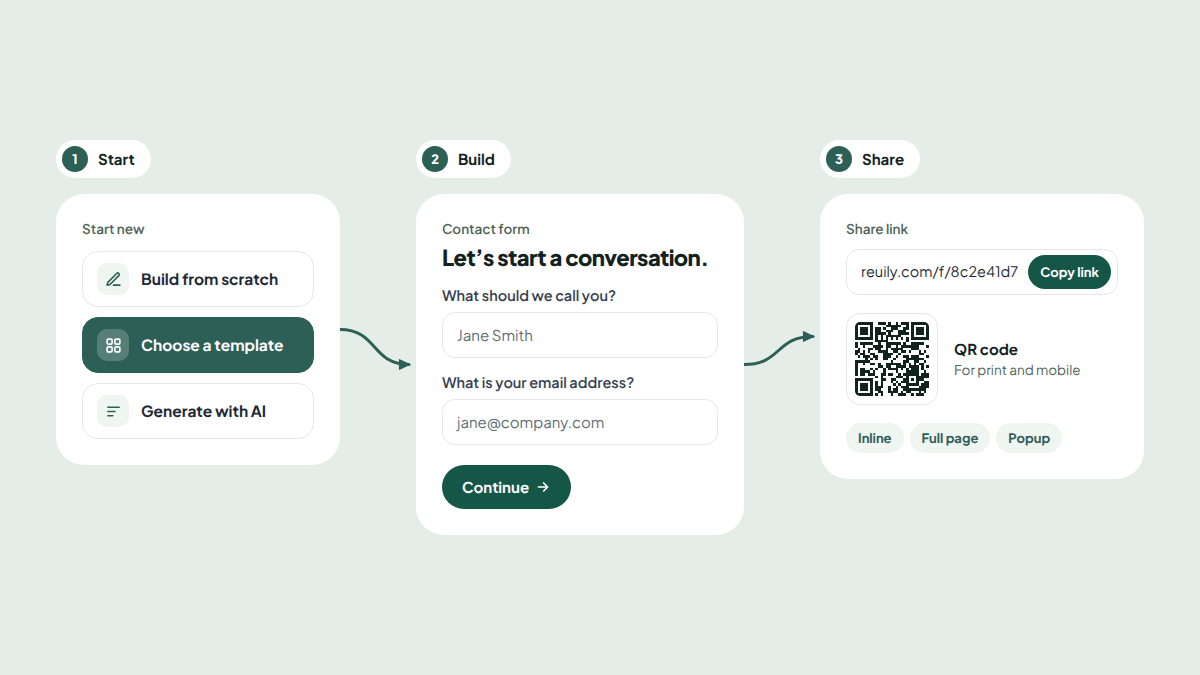
- Start from the template. Open the NPS survey template in Reuily (opens in a new tab), or add the Net Promoter Score question to any form. You can change the labels at each end of the scale.
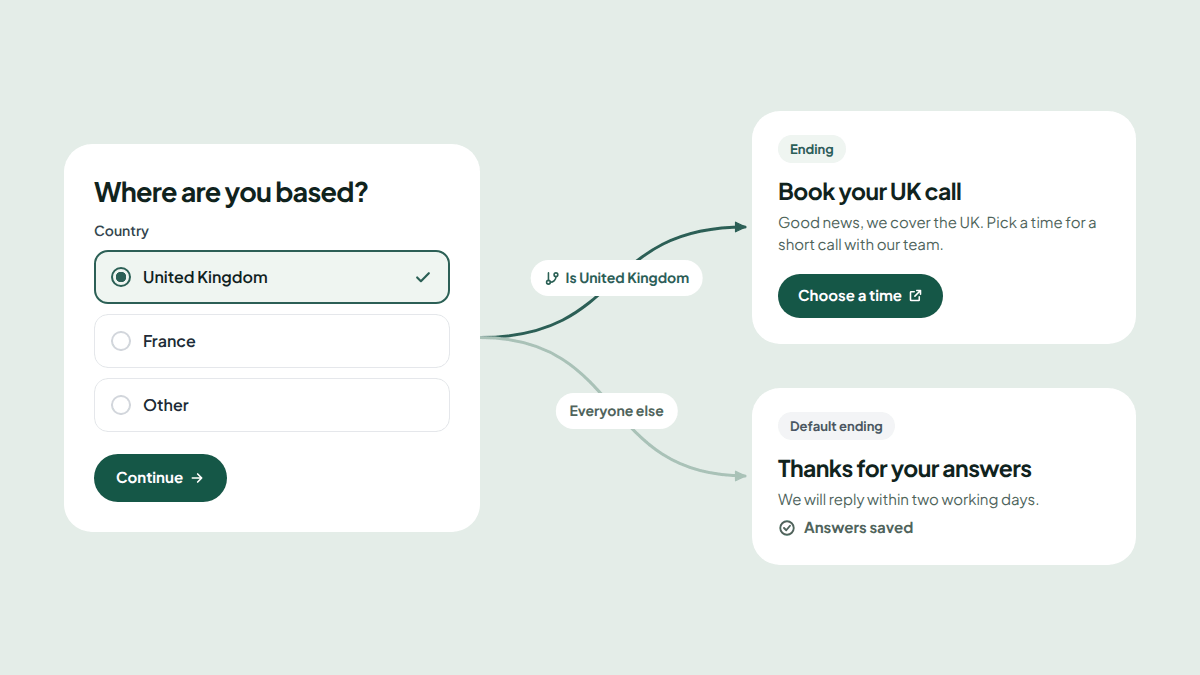
- Follow up with detractors. In the Flows tab, add a rule: if the score is less than 7, go to a page that asks what you could do better.
- Ask promoters for a review. Add a second Thank You page with a website button that links to your review page, and a rule that sends scores of more than 8 there.
- Share it. Send the link in an email, show a QR code, or embed the survey on your website.
- Read the results. Open the Summary tab to see your score, and connect Google Sheets if you want every answer in a spreadsheet.
New to rules? See how conditional logic forms work in Reuily.
When to send an NPS survey
- Relationship surveys measure how people feel about you overall. Send them every three to six months.
- Transactional surveys measure one experience, such as onboarding, a purchase or a support chat. Send them soon after it happens.
Pick one rhythm and keep it, so your scores stay comparable over time.
NPS survey best practices
- Keep it short. One score and one reason is enough for most surveys.
- Ask the score first. It is quick to answer and gets people started.
- Reply to detractors quickly. Reach out within a few days, while the experience is fresh.
- Close the loop. Tell customers what you changed because of their feedback.
- Watch the trend. A single score matters less than whether it is going up or down.
Start your NPS survey
Reuily is a free form builder with unlimited responses on every plan, including the Net Promoter Score question and your score in the results.
Use the NPS survey template (opens in a new tab) to send your first survey, or compare it with the customer satisfaction (CSAT) survey template.
Frequently asked questions
What is a good NPS score?
Any score above 0 means you have more promoters than detractors. Many teams see 30 or more as good and 50 or more as excellent, but scores vary a lot by industry, so your own trend over time matters most.
How many questions should an NPS survey have?
Two or three. Ask the 0 to 10 question first, then one open question about the reason for the score. Add a third only if you need it, such as a question for detractors about what to improve.
How often should you send an NPS survey?
For a general view of how customers feel, every three to six months works for most teams. For feedback on one moment, such as onboarding or a support chat, send it soon after that moment. Avoid asking people more often than you can act on the answers.
Should NPS surveys be anonymous?
They can be. Anonymous surveys often get more honest answers, but you cannot follow up with an unhappy customer. A common middle ground is an optional email question at the end.
What is the difference between NPS and CSAT?
NPS measures loyalty by asking how likely people are to recommend you. CSAT measures satisfaction with one experience, usually on a 1 to 5 scale, right after it happens. Many teams use both, and Reuily has a template for each.
Can I create an NPS survey for free?
Yes. Start from the free net promoter score survey template in Reuily. The Free plan includes the Net Promoter Score question, unlimited responses and the score calculation in your results, with no card needed.