Key points
A self-evaluation is your own written review of your work over a set period, which your manager reads before your performance review.
Lead with results you can measure, then cover skills, one honest area to improve and clear goals for the next period.
Write in the first person, keep each answer to two or three sentences, and back every claim with an example.
Reuily has a free employee self-evaluation form template that collects every answer before the review meeting.
On this page
Review season is here, and you have to write about your own work. These employee self-evaluation examples give you words to start from, without sounding boastful or too modest.
They are sorted by skill and by type of review, so you can pick the ones that fit your role. If you manage a team, send everyone the free self-evaluation form, so every answer arrives before the meeting.
What is a self-evaluation?
A self-evaluation is a written review of your own work over a set period, such as the last six or twelve months. You describe your results, strengths, areas to improve and goals. Your manager reads it before your performance review, so the meeting starts from your view of the year as well as theirs.
Many companies call it a self-assessment or a self-performance review. The questions are much the same:
- What did you achieve?
- How would you rate your performance?
- Where do you want to grow?
- What support do you need?
How to write a self-evaluation
- Gather your evidence first. Look through your calendar, sent emails, project notes and any praise you received. Write down results with numbers, such as sales, deadlines met or tickets closed.
- Start with your biggest wins. Pick two or three results that mattered most to your team. Say what you did and what changed because of it.
- Connect your work to your goals. Go through the goals you set last time. Say which you met, which you missed and why.
- Name one area to improve. Choose something real, give an example and say what you will do differently.
- Set goals for the next period. Make them specific enough that you and your manager will both know when you have reached them.
- Read it once as your manager would. Cut vague words, check every claim has an example, and keep each answer to two or three sentences.
Employee self-evaluation examples for work
Each example below is written in the first person. Swap in your own projects and numbers, because specific results are what make a self-evaluation convincing.
Achievements and results
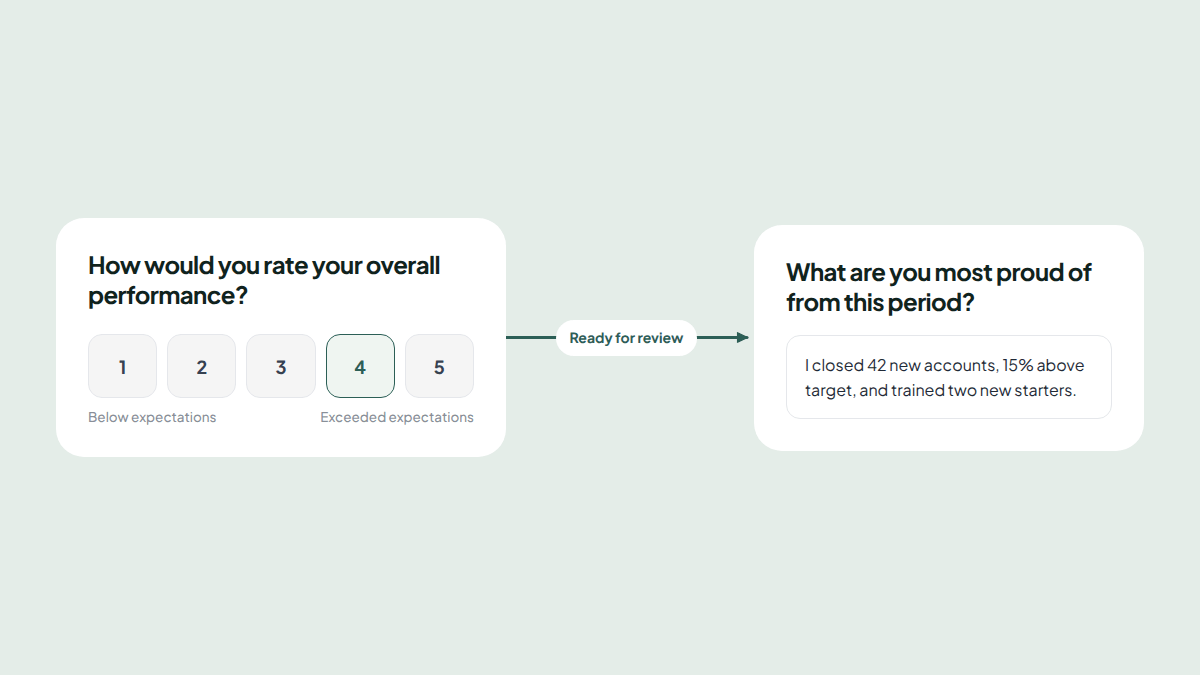
- "I closed 42 new accounts this year, 15% above my target, and kept 96% of my existing clients."
- "I led the move to our new booking system. We finished two weeks early, and missed appointments dropped by a third."
- "I cut our monthly report time from two days to half a day by building one shared spreadsheet the whole team uses."
- "I handled 1,200 support requests this year with a 94% satisfaction rating, the highest on my team."
- "I launched the spring campaign on time and on budget. It brought in 380 sign ups, nearly double last year's."
- "I trained three new starters, and all three were working on their own within their first month."
Communication self-evaluation examples
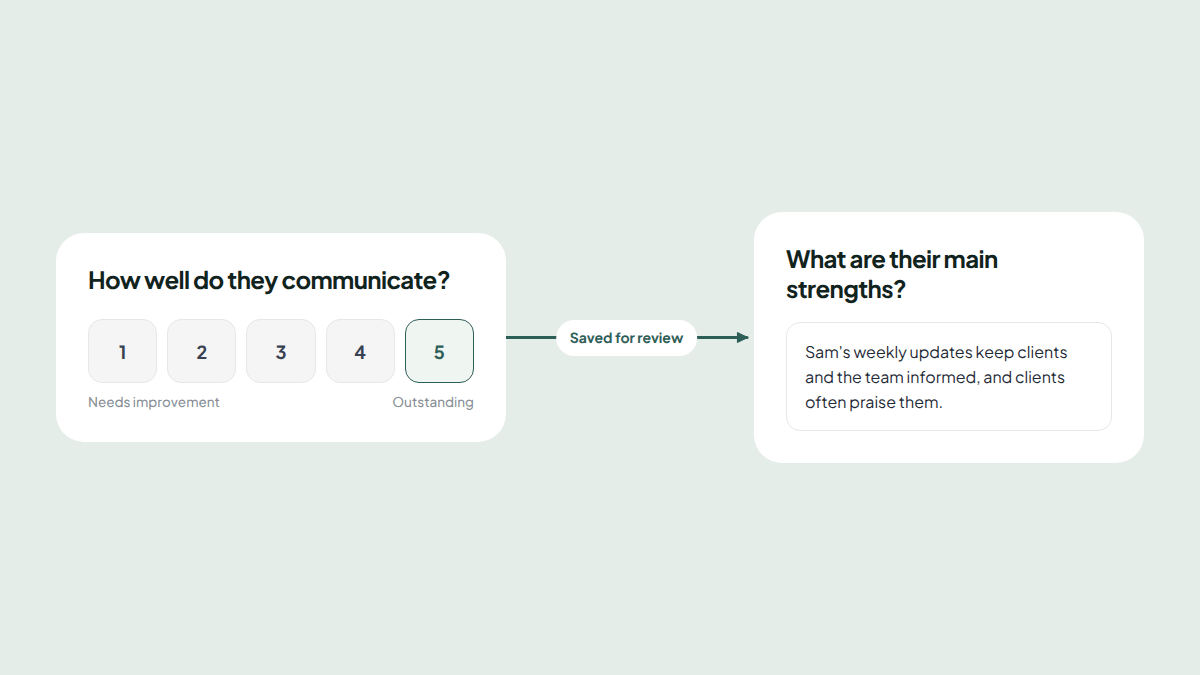
- "I send a short weekly update to my project's stakeholders, so nobody has to chase me for progress."
- "I explained the new pricing to our sales team in a 20 minute session and a one page guide. Questions to my inbox dropped right after."
- "I listen before I respond in difficult conversations. Two unhappy clients renewed this year after I talked their concerns through with them."
- "I am working on keeping my emails shorter. I now put the main point or request in the first line."
- "I presented our team's results at the quarterly meeting for the first time and got clear, positive feedback from leadership."
Teamwork and collaboration
- "I stepped in to cover a colleague's accounts during their leave, and none of their clients had a gap in service."
- "I work closely with the design team. We agreed on a simple request process that has cut back and forth on every project."
- "I share what I learn. I wrote three how-to guides for our shared drive that new team members use every week."
- "I ask for help early when a deadline is at risk, instead of waiting until it is too late to change the plan."
- "I helped two teams settle a disagreement over priorities by bringing them together with the facts on one page."
Quality of work and job knowledge
- "My reports go out with very few corrections. My manager approved 11 of my last 12 without changes."
- "I check my own work against a short list before I hand it in, which has stopped repeat mistakes."
- "I completed the advanced Excel course this year and now build the team's forecasts myself."
- "I know our product well enough that colleagues come to me with customer questions they cannot answer."
- "I keep up with changes in our industry and shared two updates that changed how we price small contracts."
Productivity and time management
- "I met every deadline this year, including during our busiest quarter, by planning my week every Monday morning."
- "I prioritise tasks by impact, so the work that matters most to clients gets done first."
- "I sometimes say yes to too many requests. I now check my workload before I commit to new work."
- "I set up email templates for common questions, which saves me about three hours a week."
- "I block two hours each morning for focused work, and my output on big projects has improved because of it."
Accountability self-evaluation examples
- "When I made a pricing error in March, I told my manager the same day, fixed it with the client and added a check so it cannot happen again."
- "I own my projects from start to finish and follow up until each one is complete."
- "I missed my goal for new referrals. I relied too much on existing clients, and I have a plan to fix that next quarter."
- "I do what I say I will do. If something changes, I let people know before the deadline, not after."
Customer service self-evaluation examples
- "I solve most customer problems on the first call, and my repeat contact rate is the lowest on the team."
- "I keep calm with upset customers and focus on what I can do for them, not on what went wrong."
- "I collect common complaints and share them with the product team each month. Two led to fixes this year."
- "I follow up with customers after a problem is solved to check they are happy, which has led to several positive reviews."
Leadership self-evaluation examples
- "I hold a 15 minute check-in with each person on my team every week, and nobody on my team left this year."
- "I give feedback in the moment, not just at review time, so small problems never grow into big ones."
- "I set clear goals for the team at the start of each quarter and share our progress every two weeks."
- "I am learning to delegate more. I handed two projects to senior team members, and both went well."
- "I make sure quieter team members are heard in meetings by asking for their views directly."
Strengths examples
- "My biggest strength is solving problems under pressure. During the system outage in June, I kept clients updated and found a workaround within the hour."
- "I am organised. I keep clear notes on every account, so anyone can pick up my work if I am away."
- "I build good relationships quickly. Three new clients asked for me by name this year."
- "I explain complex topics in simple words, which helps clients make decisions faster."
- "I learn new tools fast and often help others get started with them."
Areas of improvement examples
These are honest about a weakness and show a plan, which is what managers look for.
- "I want to speak up more in larger meetings. I will share at least one idea in each team meeting this quarter."
- "I can spend too long perfecting small details. I am setting time limits on smaller tasks so bigger work does not wait."
- "I need to get better at saying no. I will check new requests against my priorities before I accept them."
- "My technical writing could be clearer. I signed up for a writing course and will ask a colleague to review my next three documents."
- "I tend to work alone on hard problems. I will ask for input earlier, so we find solutions faster as a team."
Goals for the next period
- "Grow my client list by 10% by the end of next year, mainly through referrals."
- "Lead one project from start to finish, including the budget and the final presentation."
- "Complete a project management course by June and use it to plan our summer launch."
- "Reduce the time it takes to answer customer emails from one day to four working hours."
- "Mentor one new team member through their first three months."
Self-evaluation examples for different reviews
End of year self-evaluation examples
- "This year I focused on keeping our biggest clients. All ten renewed, and four increased their contracts. Next year I want to bring the same care to winning new clients."
- "My proudest result this year was cutting our delivery time by 20%. My main goal for next year is to share that process with the other two teams."
Mid-year self-evaluation examples
- "I am on track for three of my four goals. I am behind on the training goal because of the system move, and I have booked the course for August to catch up."
- "The first half of the year was about learning the new role. In the second half I want to take on more client calls on my own."
First 90 days self-evaluation examples
- "In my first 90 days I learned our main tools, met every key client and took over the weekly report. I would like more time with the sales team to understand their process."
- "I settled in quickly and finished my first project a week early. My next step is to learn our pricing well enough to quote without help."
A full self-evaluation example
Here is a complete sample answer for an account manager's end of year review. It uses the same questions as Reuily's self-evaluation form.
- What are you most proud of from this period? "I kept all ten of my largest accounts, and four of them increased their contracts. I also trained two new starters, who now manage their own clients."
- How would you rate your overall performance? 4 out of 5. "I met or beat three of my four goals."
- Which goals did you meet, and which did you miss? "I beat my renewal and upsell targets. I missed my goal of eight new clients and won five, because I spent the first quarter on the system move."
- What got in the way of your best work? "The system move took more time than planned. Earlier training for the whole team would have helped."
- Which skill do you want to grow next? "Finding and winning new clients, especially through referrals."
- What are your goals for the next period? "Win eight new clients, run one referral campaign by June, and present our account results at two team meetings."
- What support do you need from your manager? "Time on two sales calls a month with a senior colleague, so I can learn how they win new work."
Phrases to avoid in a self-evaluation
- Vague praise. "I am a hard worker" says little. Show it with a result: "I covered two roles for six weeks and hit every deadline."
- Blaming others. Explain what got in the way and what you learned, without naming colleagues as the cause.
- Weaknesses that are secretly strengths. "I care too much" does not convince anyone. Pick a real area and a plan.
- Words like always and never. They are hard to believe and easy to disagree with. Use real numbers instead.
- Surprises. If something went wrong, your manager should already know. Use the review to show what you learned.
How to collect self-evaluations from your team
If you manage a team, a form makes self-evaluations easier for everyone. Each person answers the same questions, and you read every answer in one place before the meeting.
- Start from the template. Open the employee self-evaluation form template (opens in a new tab) in Reuily. It asks for wins, a self rating from 1 to 5, goals met and missed, a skill to grow, next goals and the support each person needs.
- Edit the questions. Add your company values or job-specific skills, and change the list of review types to match how you run reviews.
- Share the link. Send it to your team about a week before reviews, so people have time to think.
- Read the answers. Every self-evaluation lands in your Submissions, with the date it was sent. Connect Google Sheets if you want every answer in a spreadsheet.
You can preview every question on the self-evaluation form template page first.
Next steps
Your manager will write their own review, often using a performance review form. To see what managers write, read these performance review examples, or use the free performance review form template if you run reviews yourself. For other HR forms, browse all free templates.
Frequently asked questions
What should I write in my self-evaluation?
Write about your biggest results, the skills you used to get them, one area you want to improve and your goals for the next period. Give a real example or number for each point, so your manager can see the impact of your work.
How do you write a self-evaluation with no big achievements?
Focus on steady work and growth. Mention tasks you handled reliably, problems you solved, people you helped and skills you learned. Steady, dependable work is an achievement, and saying so plainly is better than inflating a small win.
How should I rate myself in a self-evaluation?
Rate yourself honestly, using the same scale your manager uses. If you met your goals, a rating in the middle or just above is fair. Back any top rating with clear results, and explain any low rating with what you will change.
How long should a self-evaluation be?
Two or three sentences per question is enough for most reviews, or about one page in total. Your manager reads several of these, so short answers with specific examples work better than long paragraphs.
How do you write about weaknesses in a self-evaluation?
Pick one real area to improve, give an example of when it held you back, and say what you are doing about it. This shows self-awareness and a plan, which managers value more than a weakness disguised as a strength.
What are good examples of strengths for a self-evaluation?
Good strengths are specific and proven, such as solving customer problems on the first call, explaining complex work in simple terms, or hitting every deadline in a busy quarter. Name the strength, then give the example that shows it.